
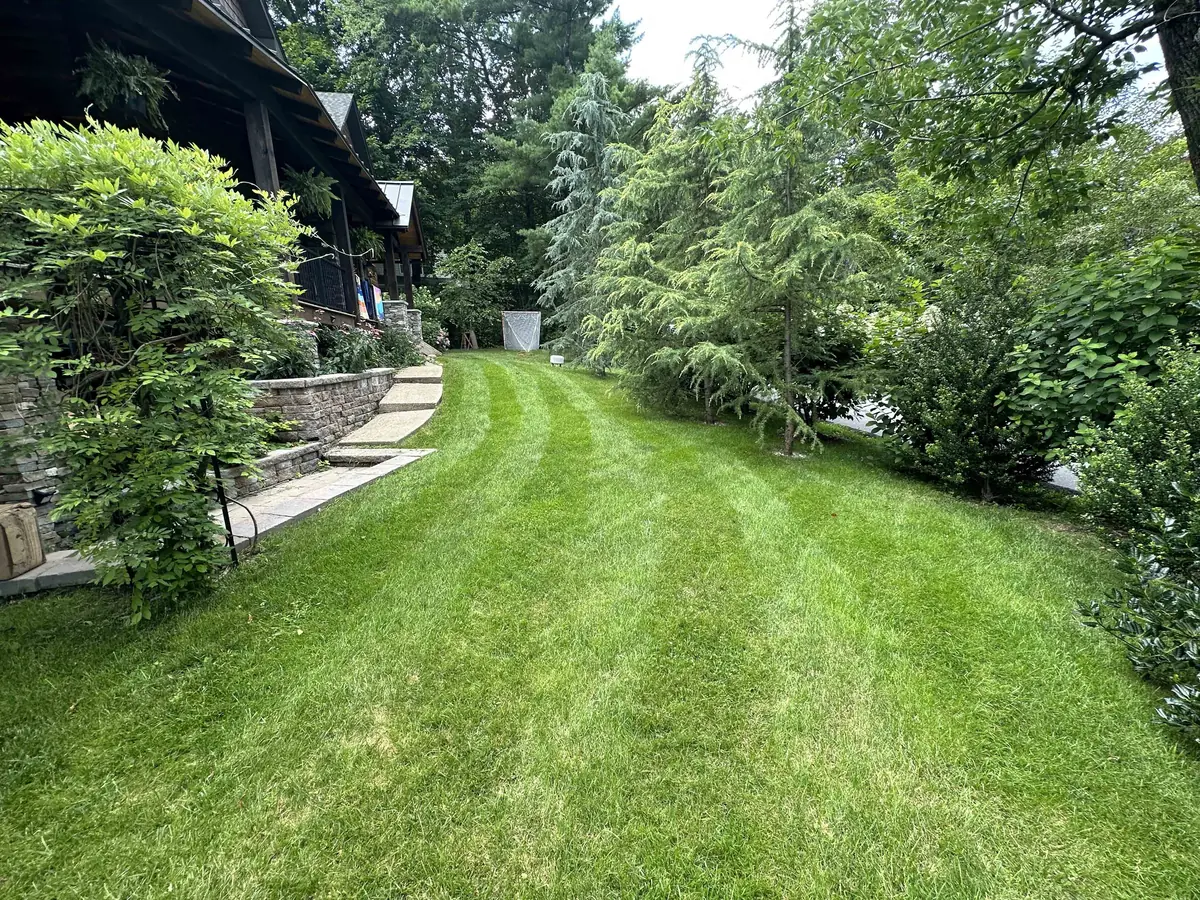
Lynchburg sits at 630 feet in the Piedmont, in the foothills of the Blue Ridge, and it is USDA hardiness zone 7b on the 2023 map. The detailed Extension calendar that surfaces for most Virginia lawn searches is the York/Poquoson "Peninsula Area" one — written for Yorktown, near sea level, in zone 8a. Fall arrives earlier here and spring arrives later. Most of the practice in that calendar is right; some of the dates are not.
Why the calendar you found is probably the wrong one
Search for a Virginia lawn care calendar and you will almost certainly land on Virginia Cooperative Extension's Peninsula calendar. It deserves its ranking — it is genuinely detailed and genuinely authoritative. It is also written for a different place.
The Peninsula is Coastal Plain: near sea level, moderated by water on three sides, and a full half-zone warmer than the Piedmont. Lynchburg is inland and 630 feet up. Soil here warms later in spring and cools sooner in autumn. That single difference moves several dates in opposite directions depending on the season, which is exactly the kind of error that is easy to make and hard to notice.
| Task | Peninsula (published) | Lynchburg |
|---|---|---|
| Fall seeding window | Sept 1 – Oct 1 | Same or slightly earlier — autumn cools sooner inland |
| Overseeding cutoff | Not recommended after Oct 15 | Oct 15 is the practical edge, not a soft guideline |
| Crabgrass pre-emergent | Approx. March 5–10 | Later — use soil temperature, not the date |
Lynchburg is zone 7b now, and that matters
On the 2023 USDA plant hardiness map, Lynchburg is zone 7b — an average annual minimum temperature of 5 to 10°F — with the edges of the city spanning 7a and 7b. On the previous 2012 map it was 7a.
That change is real rather than a correction of an old error. The 2023 map was built from 1991–2020 weather data, where the 2012 map used 1976–2005, and roughly half the country shifted a half zone warmer as a result. The practical consequence is specific and easy to miss: any guidance written before late 2023 is citing the wrong zone for Lynchburg, and that includes most of what is online and most of what homeowners remember.
Frost dates and the length of the season
The averages for the Lynchburg Regional Airport station are a last spring frost around April 15 and a first fall frost around October 25, which gives a growing season of roughly 193 days.
Treat those as the centre of a range rather than a promise. They come from a single airport station, and airport stations typically run a little warmer than the surrounding countryside — real frost out in Forest or Bedford County can land a week off in either direction. Any given year varies two to three weeks from the average.
Fertilizing: the fall is the whole game
For cool-season grass, Extension summarises the fertilizer year as "SON" — September, October, November. That is the backbone of the program, not a supplement to spring feeding.
| Month | Rate |
|---|---|
| September | 0.7 lb |
| October | 0.7 lb |
| November | 0.5 lb |
| April – May | 0.5 – 0.7 lb combined |
| June – August | None |
The annual total lands at 2.0 to 3.5 lb of actual nitrogen per 1,000 sq ft, or 2.0 to 2.8 lb if at least half of it is slow-release. Allow 30 days between applications.
Two things worth knowing. Summer nitrogen on fescue is not a boost, it is a stress — the June to August "none" is deliberate. And you will find sources online insisting you must not fertilize after March 15; VCE 430-011 clearly schedules an April–May application, and the Extension publication is the one to trust.
Seeding and aeration
The Piedmont fall seeding window runs from mid-August through mid-October, and the tight optimum is September 1 to October 1. Extension does not recommend overseeding after October 15, because soil temperature is no longer reliably warm enough for fescue to germinate.
In practice that October date is the edge of the optimal window rather than a wall. Seed goes down later than that on real properties and some of it takes. But the further past the optimum you go, the more of the bag you are gambling, and a thin strike in November cannot be fixed until the following autumn.
- Overseeding rate: 4 lb of turf-type tall fescue per 1,000 sq ft is the Extension figure. Several commercial sources say 6–8 lb; the number above is the one from the research.
- Aerate in the fall only. Core aeration and dethatching belong in autumn for cool-season grass, when recovery is best. Core aerate and seed the same day so the seed drops into open holes.
- Sequencing: if you fertilize before overseeding, wait two weeks before putting seed down. New grass wants two or three mowings before its next feeding.
Spring seeding does not work, and it is worth being blunt about it
Fescue sown in spring cannot build enough root depth to survive its first Virginia summer. It comes up, it looks like a success for six weeks, and then it dies in July. Fall seeding gives the grass two cool seasons to establish — the autumn it goes down and the spring after it — before it ever meets real heat. This is the single most common homeowner mistake here and the most counterintuitive.
Mowing height
Tall fescue does best cut at 3 to 3.5 inches, with the deck raised through the summer. A taller cut shades the soil surface, keeps roots cooler through summer stress, and helps crowd out crabgrass before it starts — it does more work than most homeowners expect from a single setting.
Two rules matter more than the exact number: never remove more than a third of the blade in one cut, and mow only when the grass is dry.
You may see 2 inches quoted in VCE 430-520 against "3 inches or higher" in the Peninsula calendar. Those appear to be different contexts rather than a genuine disagreement — the lower figure relates to newly established turf. For an established lawn, the taller number is the one to work to.
Crabgrass pre-emergent, and the forsythia rule
Crabgrass germinates once soil reaches 55°F at a two-inch depth for several consecutive days. The herbicide needs time to bind before that happens, so the application window is 50 to 55°F.
Which brings us to the piece of folk wisdom everyone repeats: put pre-emergent down when the forsythia blooms. It is close enough to be believable and wrong in a way that costs you the season.
Forsythia blooms at roughly 55–60°F soil temperature — which is the back of the application window, or already past it. By full bloom you may be late. The workable version of the rule is to apply when full forsythia bloom is still one to two weeks away. Note that Extension's own calendar says "first week of bloom," not full bloom.
Better still, skip the shrub and buy a soil thermometer. A calendar date imported from the Coastal Plain will run early for Lynchburg, and the amount it runs early varies year to year. Soil temperature is the actual trigger, and it costs about fifteen dollars to measure it properly.
Leaf drop: the trees do not finish together
Mid-Atlantic peak colour runs from mid-October into early November. The Richmond area peaks around October 20 to November 1; Lynchburg is inland and slightly higher, so expect the same or marginally earlier.
The detail that actually affects scheduling is that different species let go at different times:
- Maples drop soon after peak colour — mid-to-late October.
- Oaks and hickories hold dry leaves long after everything else is bare, frequently into winter.
So a single cleanup timed to the maple drop leaves the oak drop still to come. That is a scheduling fact rather than a sales pitch — and it cuts both ways. A property that is all maple may genuinely be done in one visit. How many passes a property needs comes down to its tree mix and to what the customer actually wants, which is why we quote it per property rather than selling a fixed package.
If leaves are the part you would rather not deal with, that is what our leaf removal service covers.
Snow, briefly
Lynchburg averages 12 to 14 inches of snow a year. The first measurable snowfall typically arrives in December and the last in March, with February the snowiest month at around 4.2 inches. It is not a lawn task, but it is the other half of the calendar for anyone maintaining a property here — see snow removal.
Questions we get asked
What USDA hardiness zone is Lynchburg, VA in?
Zone 7b on the 2023 USDA map, with the edges of the city spanning 7a and 7b. It was 7a on the 2012 map. The 2023 map used 1991–2020 weather data against the older map's 1976–2005, and about half the country shifted a half zone warmer. Advice written before late 2023 cites the wrong zone for Lynchburg.
When should I overseed my lawn in Lynchburg?
The tight optimum is September 1 to October 1. Extension does not recommend overseeding after October 15, because the soil is no longer warm enough for reliable fescue germination. Later seeding is possible but increasingly a gamble.
Can I seed fescue in the spring instead?
No. Spring-sown fescue cannot build enough root depth to survive its first Virginia summer. It looks fine for a few weeks and then dies in July. Fall seeding gives the grass two cool seasons to establish before it meets heat.
When should crabgrass pre-emergent go down?
Use soil temperature rather than a date. Crabgrass germinates at 55°F at a two-inch depth, so apply at 50–55°F to let the herbicide bind first. The forsythia rule runs late — forsythia blooms at roughly 55–60°F soil temperature. Apply when full bloom is still one to two weeks away.
How short should tall fescue be cut?
3 to 3.5 inches, with the deck raised through summer. Never take more than a third of the blade in one cut, and mow only when the grass is dry.
Why might one leaf cleanup not be enough?
Because the trees do not finish together. Maples drop in mid-to-late October while oaks and hickories hold on into winter, so a single pass timed to the maples leaves the oak drop behind. A maple-only property may well be done in one visit — it depends on the tree mix and on what you want.
Want this handled on a schedule instead of a calendar? We serve Lynchburg, Forest, Bedford and Campbell County.
Get a Free QuoteSources
Everything above is either published by Virginia Cooperative Extension and the agencies below, or is our own operating practice, which is labelled as such where it appears. Where sources disagree, we have said so rather than picking the tidier number.
- Virginia Cooperative Extension 430-011, Lawn Fertilization in Virginia — pubs.ext.vt.edu/430/430-011
- Virginia Cooperative Extension 430-520, Fall Lawn Care — pubs.ext.vt.edu/430/430-520
- Virginia Cooperative Extension, York/Poquoson Lawn Maintenance Calendar (Peninsula Area) — york.ext.vt.edu
- USDA Plant Hardiness Zone Map, 2023 revision — planthardiness.ars.usda.gov
- Frost dates, Lynchburg Regional Airport station — garden.org frost date database
- Snowfall and precipitation normals — usclimatedata.com
- Fall foliage timing — Virginia Department of Forestry